Screenshots show the Chinese version. The game is available in English, Japanese and Chinese. Open the game directly ↗
01 / A real problem
Why do we need RAG?
Imagine a company
with a large collection of internal documents.
Employees want to ask AI directly,
instead of searching through every document themselves.
A question at work
“Our product has this problem.
What should we do?”
An LLM does not inherently know these documents.
It may not have the latest information either.
02 / The basic idea
Find information first. Then answer.
RAG (retrieval-augmented generation) brings external information into the answering process.
- UserAsk a questionWhat needs to be resolved?
- RetrievalFind relevant informationSearch external sources
- Input to the LLMQuestion + retrieved informationGive the model material to refer to
- LLMGenerate an answerAnswer using this information
One detail deserves attention
Finding “similar” material
does not necessarily mean finding material that “helps answer” the question.
03 / From explanation to play
Now it is your turn to find information.
Let a small robot carry the documents,
so you can see what your choices change.
Set complex models and databases aside for now.
Small questions from a tea shop simplify the real-world setting.
- The robot
- The character you control carries the information you select. It is neither the LLM nor a complete retrieval system.
- Documents on the desks
- External information you can look up, such as opening hours and drink prices.
- The LLM reply desk
- The answerer appears in level 4. It receives the question and documents and writes a reply.
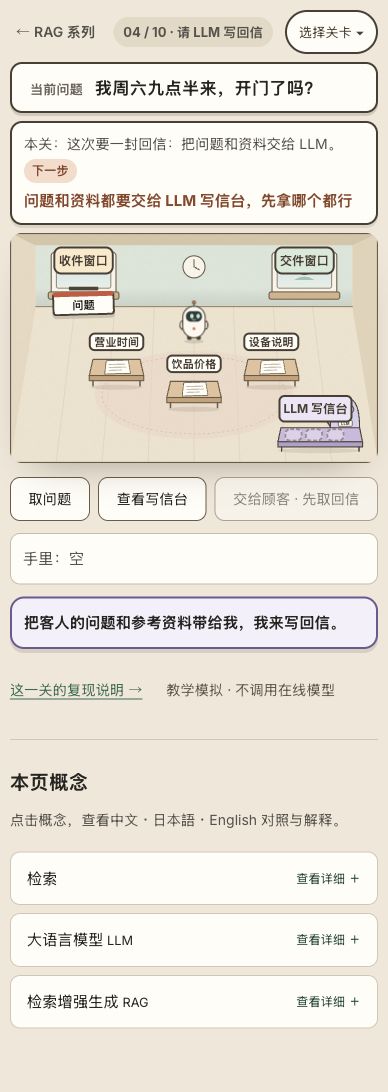
Open the image to see the full original screenshot.
This is a deterministic teaching simulation.
Documents, retrieval results and replies are prewritten. No real embedding, retrieval or LLM runs here.
04 / Into the existing game
First, find the right page.
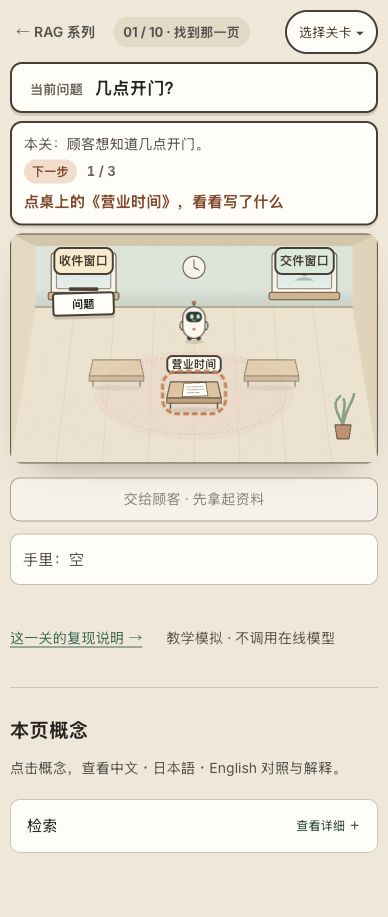
Your task
A customer asks: “What time do you open?”
- Read the current question.First identify the information the customer needs.
- Select “Opening hours” on the desk.On mobile, inspect it and then choose the pick-up action. On desktop, click to pick it up.
- Hand the document to the customer.On mobile, use the hand-over action; on desktop, click the delivery window. The game gives feedback and a level recap.
In levels 1–3, choose documents and hand them directly to the customer.
The reply desk appears in level 4; retrieval tools begin in level 5. If you choose the wrong information, use the feedback to try again.
05 / Looking back · From play to understanding
A good answer depends
on more than the model.
Remember the document
that ranked first?
In level 5, “New drink promo” mentioned pearl milk tea,
but did not provide the information needed to answer the price question.
Even if the answerer can understand the question,
unsuitable material or missing evidence can still lead to failure.
So designing RAG means considering not only the LLM,
but also how information is prepared and retrieved.
The documents, candidate order and replies in this game are prewritten. Real RAG also involves embeddings, chunking and retrieval strategies. This experience only builds an intuition.
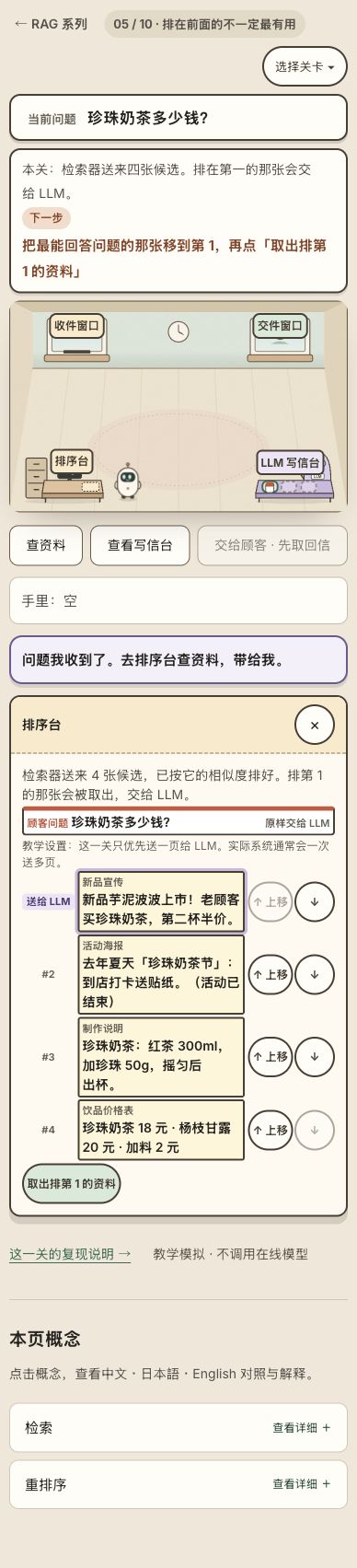
Mentioning the same drink does not mean answering its price.